Barbie Dreamhouse Adventures
- 4.2
- Rating
- 100.00M
- Installs
- Free
- Price

 Analysis by App-foxy
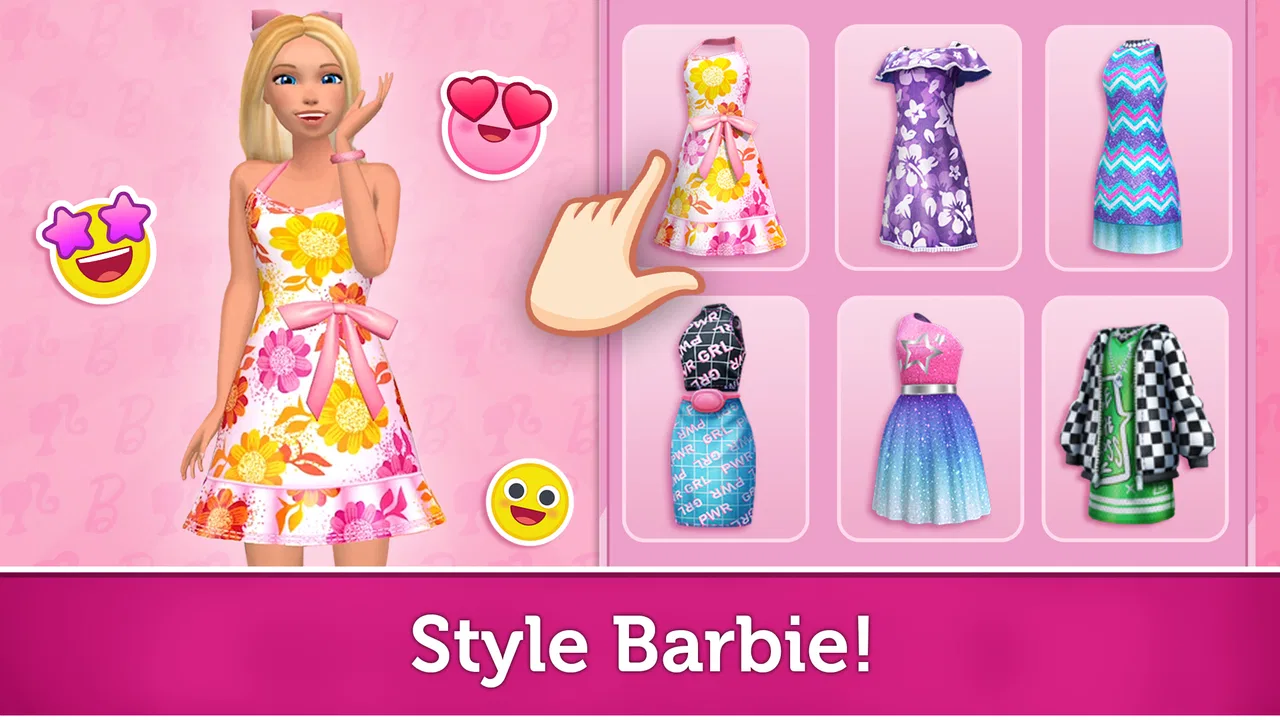
Barbie Dreamhouse Adventures is the kind of game I would hand to a younger player who enjoys decorating spaces, changing outfits and moving between small creative activities rather than chasing difficult goals. I approached it as a simulation game, and that description fits: the pleasure comes from arranging, styling and experimenting inside Barbie’s world. It is free to start, aimed at Everyone, and developed by Budge Studios, so the experience is clearly designed to be approachable rather than demanding.
My first impression was that the game works best when treated as a digital playset. It is not trying to replace a deep life simulator or a competitive fashion game. Instead, it gives children a familiar character, a colorful home and several ways to create short play sessions. I could move from choosing clothes to changing a room’s look, then try another activity when the first one stopped feeling fresh. That variety matters more here than any single feature.
How I Would Decide Whether It Fits
The main question is not whether the game has enough content to keep every player busy forever. The better question is whether the player enjoys open-ended pretend play. If the answer is yes, the combination of fashion, design, cooking, makeovers and nail-focused activities gives the game a useful range. If the player wants precise objectives, complex strategy or a strong sense of progression, I would look elsewhere.
You May Also Like

 AccuWeather: Weather Radar
AccuWeather Review: A Quick, Clear Forecast for Everyday Decisions
For everyday plans, the best forecast is the one you can understand quickly. AccuWeather makes rain timing, radar, and local conditions easy to act on, with a few trade-offs.

 Hill Climb Racing
Why Hill Climb Racing Still Turns Crashes Into One More Run
A tiny car, a bumpy hill and one more upgrade: Hill Climb Racing keeps resurfacing because its simple chaos makes every near-miss feel personal.

 AliExpress - Shopping App
AliExpress Makes Global Shopping Feel Personal, but Shoppers Bear the Risk
AliExpress turns a global marketplace into a pocket-sized discovery engine. Its reach is useful, its shopping loop compelling, and its trade-offs easy to miss.

 Lords Mobile: Kingdom Wars
Lords Mobile Is a Kingdom-Building Routine, Not a Quick Match
A case-by-case verdict on the building, battles, device demands, and social commitments that make Lords Mobile rewarding for some players and exhausting for others.

 PDF Scanner app - TapScanner
TapScanner Makes Paperwork Easier to Capture, Check, and Share
TapScanner makes scanning with a phone feel less like a rescue operation and more like a dependable step in getting work done. Its capture tools are useful, though not flawless.

 Block Blast!
 Shows How Much a Puzzle Game Can Leave Out
A quiet grid game shows why puzzle players increasingly value instant clarity, repeatable skill and low-pressure play—and where the genre still needs to catch up.
More From Our News Desk
View All News


I would also consider the player’s age and patience. The Everyone rating makes the game suitable for a broad audience, but younger children may still need an adult to help with device settings and purchases. The controls are intended to be easy to understand, which is helpful for children who are more interested in making choices than learning complicated systems. Older players may enjoy it briefly, especially if they like Barbie, but could find the activities too gentle over longer sessions.
Another decision point is the type of creativity involved. This is not a drawing application where the player builds everything from a blank canvas. The creativity comes from selecting available options and combining them. That makes it less intimidating for a child who wants immediate results, but less satisfying for someone who wants unrestricted construction. I found that distinction important: the game offers guided creativity, not a fully open design studio.
The game has a broad audience in practice, reflected by an average rating of 4.2 from around 1.2 million ratings. It has also passed the scale of a niche children’s title, with over 100 million installs. Those figures do not guarantee that every child will enjoy it, but they do suggest that the basic format is easy for many families to understand.
The strongest reason to try it
For me, the strongest reason to try it is the way it turns several familiar play patterns into one place. A child can style a character, make a room feel different, prepare something in the kitchen and then return to appearance-based play without opening another game. That makes it convenient during a short waiting period or a quiet afternoon when the player wants control without pressure.
A realistic everyday use case would be a child playing for fifteen minutes before dinner. They might begin by creating an outfit, spend a little time adjusting a room, and finish with a cooking activity. There is no need to understand a long story first, and the player can stop after a small creative task. In my experience, that low commitment is one of its most practical strengths.
I also like that the activities invite comparison without requiring competition. A child can make one look, change it, and decide which version feels better. The same approach works with rooms and other visual choices. That can encourage attention to color and style in a simple way, although I would describe it as playful exploration rather than formal learning.
Small workflows that make the game more enjoyable
One useful habit is to give each session a theme instead of tapping through every option at random. For example, I would choose a color family for an outfit, carry that idea into a room, and then pick a matching look for a makeover or nail activity. This creates a small personal challenge and makes the choices feel more connected, even though the game remains relaxed.
A second approach is to use the game as a rotation of short activities rather than staying in one area until it becomes repetitive. The fashion and design elements appeal to different moods. When outfit selection starts to feel predictable, moving to cooking or room decoration can restore interest. This is especially helpful for younger players, who may enjoy the feeling of discovery more than repeating one task.
A third tip is to let the child make the decisions while an adult stays nearby for account and purchase questions. The game is free, but optional in-app purchases range from $0.99 to $39.99 per item. I would not leave a young child to manage that part alone. The creative play can remain child-led while an adult handles the financial boundary.
Where Barbie Dreamhouse Adventures Wins
The game’s biggest advantage over narrower dress-up titles is variety. A dress-up-only game may offer more concentration on clothing, while this one broadens the session with rooms, cooking, makeovers and nails. I would choose it when the player’s interests change quickly or when siblings want to take turns choosing different activities.
It also wins on accessibility. The familiar Barbie setting gives the player an immediate starting point, and the simulation format does not demand quick reactions. I did not need to approach it like an action game. The emphasis is on tapping through choices and seeing the result, which makes it a comfortable recommendation for children who are still developing confidence with mobile games.
Another strength is the connection between character and environment. Styling a person can feel more rewarding when the surrounding space also reflects the player’s taste. Even simple changes gain context when they belong to a home rather than appearing as isolated menu selections. That relationship gives the game more personality than a basic virtual wardrobe.
The title’s long presence on mobile also works in its favor. It was released on September 11, 2018, and the current version is 2026.4.0. I see that as useful for families who prefer an established game instead of an unfamiliar new release. It supports Android devices from version 5.1 onward, which keeps the potential device range fairly broad.
Still, I would not confuse familiarity with depth. The game’s appeal depends on the player enjoying the theme and the available choices. A child who does not care about Barbie-style fashion or home activities may not be persuaded simply because the game is easy to start. The accessible design is a strength only when it matches the player’s interests.
What the free entry point really means
Because the game is free, it is easy to test without committing money at the beginning. That is valuable when a parent is unsure whether a child will enjoy the format. I would install it, watch the first few sessions and decide whether the available play is enough before considering anything optional.
The important trade-off is that free access does not mean every possible choice is included without cost. The purchase range means families should agree on a rule before the child starts: either no purchases, or purchases only with direct adult approval. That conversation is more useful than assuming the word “free” removes all spending concerns.
I also recommend judging the game by its repeat value rather than its first colorful impression. A child may be delighted by the first outfit or room and then lose interest once the novelty fades. If the player naturally invents themes, revisits designs and switches between activities, the game has a better chance of becoming a regular choice. If they only want a quick first look, the free entry point still makes that trial reasonable.
Where Other Categories May Fit Better
I would choose a dedicated dress-up game instead when clothing combinations are the only thing the player wants. A specialized alternative may feel more focused, while Barbie Dreamhouse Adventures spreads attention across several play areas. That broader design is convenient, but it also means the fashion side is not the entire experience.
For a child who wants to build detailed environments, a construction or sandbox game may be a better match. This game offers design decisions inside its own setting, but it is not the same as giving the player a blank world and unlimited building freedom. The trade-off is simplicity: Barbie’s game is easier to enter, while a sandbox usually asks for more patience and planning.
Players seeking competition should also look elsewhere. The appeal here is personal styling and pretend play, not ranking against other players or mastering difficult challenges. A competitive game may provide stronger goals and a clearer sense of improvement, but it can also bring pressure that some children do not need. I would select this title specifically when a calm, non-competitive activity is preferable.
It is less suitable for someone looking for a substantial narrative adventure. The Barbie setting provides a recognizable frame, yet the everyday enjoyment comes from activities and choices rather than from following a demanding plot. If the child repeatedly asks what happens next in a story, a narrative-led game will probably hold attention better.
There is also a difference between this game and educational applications. The activities may encourage imagination, sequencing and visual choices, but I would not use it as a replacement for a structured learning tool. Its value is recreational. That is not a weakness by itself; it simply helps parents choose it for the right reason.
Questions I would settle before installing
Will it work on an older device? The minimum operating system is Android 5.1, so the compatibility threshold is not especially demanding. I would still check the device’s available storage and performance in everyday use, particularly if it is an older phone shared by several family members. The operating-system requirement is only one part of a smooth experience.
Is it appropriate for a young child? The Everyone rating supports that choice, and the gentle simulation format is approachable. I would nevertheless supervise the first session, not because the activities are difficult, but because children may need help understanding menus, switching areas and handling purchase prompts.
Does it cost anything to download? The game is free. The practical cost question is whether the family is comfortable with optional purchases, which can reach $39.99 for an individual item. I would make the household rule clear before handing over the device, especially when the player is young enough to tap through screens without understanding money.
Can it replace a full creative sandbox? No, and I would not recommend it with that expectation. It is better understood as a themed collection of accessible creative activities. That makes it a strong fit for guided play and a weaker fit for players who want total control over every object and system.
The Cost of Switching Between Options
Switching away from this game is easy if the child only wants a quick dress-up experience, because a focused fashion title may deliver that faster. The cost is losing the convenience of having several Barbie-themed activities together. A child who enjoys moving from clothing to rooms and then to cooking may find a single-purpose alternative limiting after the initial novelty.
Moving to a sandbox game offers more freedom, but it usually requires a bigger adjustment in how the player thinks. Instead of selecting from a friendly set of choices, the child may need to plan, build and learn more systems. I would make that switch for a patient player who asks for more control, not for someone who currently enjoys immediate results.
Choosing a story-driven game changes the rhythm again. It may provide stronger motivation through events and goals, but it can reduce the freedom to simply experiment with a look or room. The right choice depends on whether the child’s favorite moment is making something personal or discovering the next part of a story.
There is also a practical switching cost for parents. A new game means learning another interface, checking another purchase model and deciding whether its content suits the household. Barbie Dreamhouse Adventures has the advantage of being straightforward to trial, so I would use it as a low-risk first step when the child’s interests are clearly aligned with fashion and pretend play.
My advice is to observe what the player does without prompting. If they independently return to change an outfit, redesign a space or combine activities into their own routine, the game is earning its place. If they ask for more difficult goals, more building freedom or a continuing story, switching is probably more productive than trying to make this game serve a purpose it was not designed for.
My Recommendation for the Right Player
I recommend Barbie Dreamhouse Adventures to younger players who enjoy Barbie, visual customization and relaxed simulation. It is especially suitable for short sessions, shared family devices and children who want several familiar activities in one colorful setting. The free starting point makes it sensible to try, while the Everyone rating and approachable controls lower the barrier for new players.
I would recommend it less strongly to older children who need deep progression, competitive play or unrestricted construction. I would also skip it for anyone who dislikes fashion, home decoration and character-centered pretend play. Those are not minor details here; they are the reason the game exists, so a mismatch in taste will be obvious.
My final decision would be to install it with purchase controls already agreed upon, then give the player a simple creative prompt such as designing a coordinated outfit and room. That test reveals more than the first few taps. If the child starts inventing themes and returning to revise choices, the game is a good fit. If the activities feel like a collection of disconnected menus, a more focused alternative will likely be better.
After spending time with it, I see the title as a friendly digital playhouse rather than a complete simulation of everyday life. Its value comes from accessible choices, a recognizable character and the freedom to move between small creative tasks. Choose it for relaxed, themed creativity—not for depth, competition or unlimited building freedom. For the right player, that focused simplicity is exactly what makes it enjoyable.
FAQs for Barbie Dreamhouse Adventures
01What is Barbie Dreamhouse Adventures about?
Barbie Dreamhouse Adventures is a simulation game where players can join Barbie and her friends in various activities within a virtual dreamhouse. It allows users to customize the house, engage in fun activities, play mini-games, and take part in exciting adventures with Barbie and her friends, all while exploring creativity.
02Is Barbie Dreamhouse Adventures free to play?
The game is free to download and play, but it includes in-app purchases. Players can buy additional items, outfits, or decorations to enhance their experience. These purchases are optional, but they can enrich the gameplay by providing access to exclusive content and features.
03What age group is Barbie Dreamhouse Adventures suitable for?
Barbie Dreamhouse Adventures is designed for children, particularly those aged 6 to 12. The game is family-friendly, featuring engaging content that encourages creativity and imagination. However, parents should be aware of in-app purchases and may want to supervise their children’s playtime.
04Does Barbie Dreamhouse Adventures require an internet connection?
While Barbie Dreamhouse Adventures can be played offline, some features require an internet connection. Online capabilities include downloading updates, accessing new content, and making in-app purchases. For a full experience, it’s advisable to connect the device to the internet periodically.
05Can I play Barbie Dreamhouse Adventures on multiple devices?
Yes, the game can be played on multiple devices as long as you use the same account. Progress can be synced across devices, allowing players to continue their adventures seamlessly. Ensure that cloud saving is enabled to keep your progress updated across all platforms.
Pros
- Engaging storyline with interactive gameplay.
- Beautiful graphics and vibrant animations.
- Regular updates with new content.
- Suitable for all ages
- especially kids.
- Encourages creativity and imaginative play.
Cons
- In-app purchases can be costly.
- Requires a stable internet connection.
- May consume significant device storage.
- Occasional bugs can disrupt gameplay.
- Limited offline functionality.

Barbie Dreamhouse Adventures
Gallery